1798
History of the Methodist Church in South Lebanon
From circuit rider John Kobler's first sermon at Deerfield in 1798 to the church on King Avenue.
In honor of the ringing of the bell at the old Methodist Church every noon lately by the Skiniya Fellowship, the South Lebanon Historical Society would like to share with the community a history of the Methodist Church in South Lebanon:
Reverend John Kobler was a Methodist circuit rider. This was taken from his diary: “At Deerfield I found a settlement of 10 or 15 families. I was invited into a sick man’s house who was a Quaker. I ask for prayers, he said “No”. I reasoned with him upon the necessity of prayer. He would hear no reason because he was raised among “Friends”, as Quakers are called). I had with me a letter of introduction to a man, living in the place, who was supposed would revive the Gospel in his home, he treated both the message and the messenger with utter contempt, saying his house was no place for preaching. I went from house to house making inquires. At last I heard that the man’s son, man above mentioned, had a wife who really was a Methodist. I hastened to the son’s house, but found the old man had been there before me and had used his utmost influence to bolt and bar every door and heart against me. Finally a Baptist by the name of David Sutton received me gladly and the next day at an early hour his house was filled with attentive listeners to whom I declared the whole council of God.” Deerfield became one of the preaching appointments of the Reverend Kobler’s Union Circuit. Twenty-six years later, in 1826, there were a total of 1,275 members in this circuit which included Deerfield, Lebanon, Dayton, Hopewell, Bellbrook, Molar’s Park, Nesbitt’s, Xenia, Wm. Davis, Union, Bethel, Goods, Brandenburg’s, Salem, Millgrove, Middletown, and others making 23 preaching appointments.
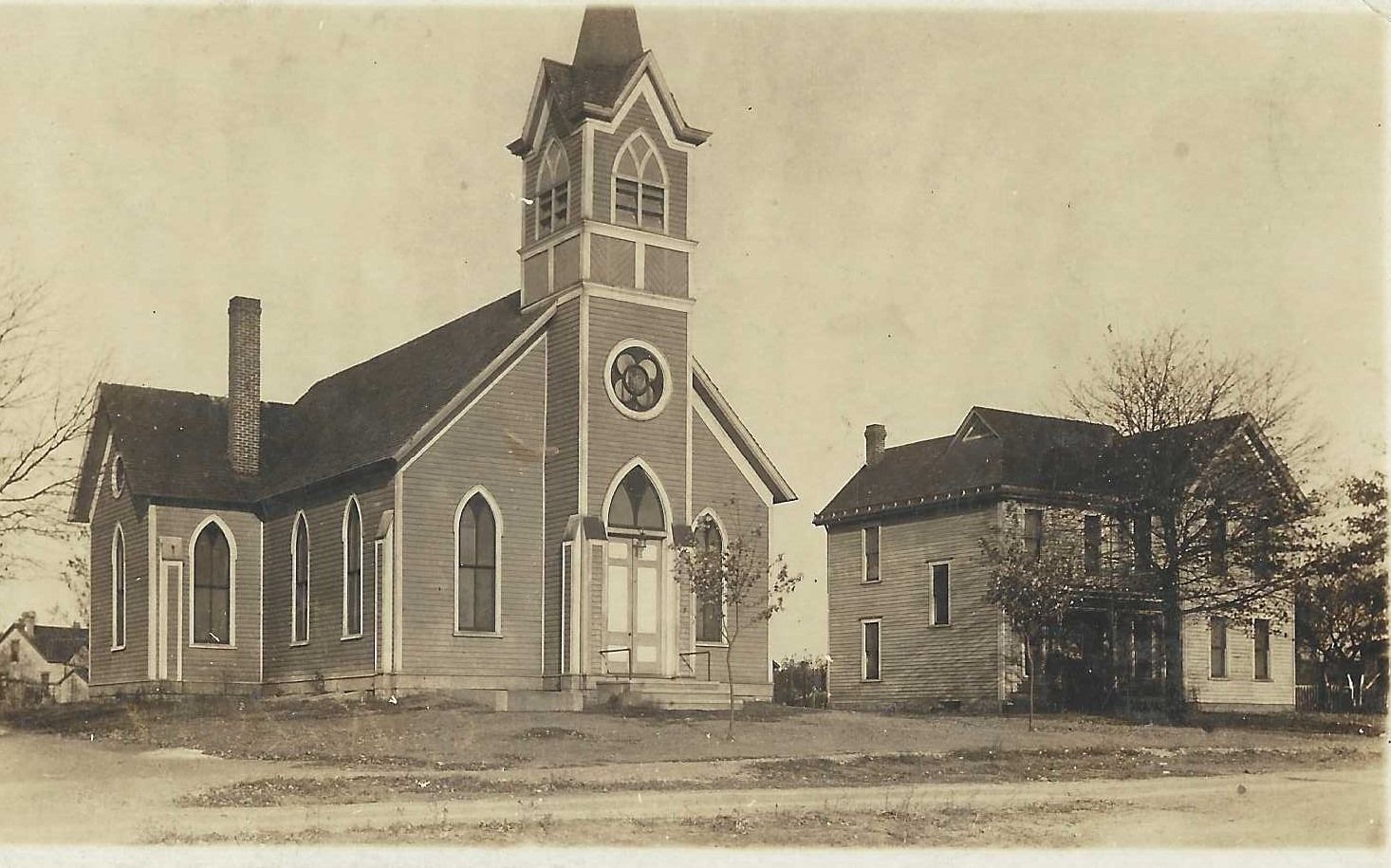
Services in Deerfield were held in the homes until 1827. At this time William & Rachel Heaton donated ½ acre of land on Mary Ellen St. The membership then built a church. During the years between 1827 and 1876 the church ministered to its people and the people met in fellowship. In 1877 a Reverend D. I. Altman came to the church. A great revival was held and the church was greatly revived and many souls found pardon. The church on Mary Ellen Street became too small and under the leadership of Reverend Altman, the trustees prepared to build a new church. The trustees prepared to build a new church. The trustees at that time were Irvin Snook, David Nuss, Stanford Green, James Nelson, Francis McCelland, James Davis and D.A. McBurney. In 1884 John & Mary Hackett in their love for the Methodist Church gave the present lot to the church. At the time this history was being made you must realize that South Lebanon was different than it is today. The bridge wasn’t where it is now but up river at the end of Mill Street (which is now called King Avenue). William Shawhan gave the timbers for the church and parsonage from his farm. The A.G. Wright Saw Mill that cut the timbers was situated near the river at the edge of Mill Street. Many, many long back breaking hours went into the building of our house of worship. Keep in mind, trees had to be cut by hand, drug to the mill by horses and then hauled by horse and wagon to the church lot. The old church was sold to Victoria Brandenburg on February 21, 1888 for four hundred dollars. In 1888 after the present church was built, the ladies of the church started a sewing circle to help pay off the debts. They baked cakes and pies and sold them to raise money. Later they were organized into the Ladies Aid Society. They were recognized by the Ohio Conference, by the Reverend Rice in 1896. The parsonage was built in 1896 & 1897 with Reverend Roberts the first pastor to reside in the parsonage. Until 1900 the church was heated by coal stoves. There were coal oil lamps in buckets on the walls for light. In 1900 the cellar was dug out and a coal furnace placed on the dirt floor. Mabel Edwards remembered when she and her brothers, Harrison & McKinley fired the furnace shoveling coal from the dirt floor. E. K. Snook was a faithful member and the builder of the alter rail and bible stand. In 1915 the Junior League bought the bible for the alter, replacing the one lost in the 1913 flood. Many papers & records were also lost. In 1919 the basement was sealed by a cement floor. The women of the church were happy they could give dinners to raise money to help the church. Until this time holding a dinner was a hassle because the pews had to be moved to the side and stacked to make room for tables. Also in 1919, E. K. Snook passed away, leaving the church twenty thousand dollars, including stocks and bonds. Due to the depression, this estate fund dropped several thousand dollars. The interest of the estate could be used currently for a period of twenty years. In 1925 many of our Ladies Aid members knows as the O.W.I. Sunday School class, under Reverend Nungester, changed the clear glass windows to the beautiful art glass we are enjoying today. The Ladies Aid Epworth League paid for two of the windows. In 1948 new furnaces were purchased from the Snook estate funds, and in 1958 the balance of the estate of E.K. Snook was used in building a recreation hall, connected with and in the back of the church. Reverend Dunn was the minister. Building committee U.E. Edwards, Sam Collier, Louis Pursley, Robert Whitacre, Tom Bradford, and Frank Bolanger.